The Rules
Before Playing:
Game components supplied:
- 1v1 Board, 2v2 Board
- 3 Character/Class Cards x 2
- 4 Item Cards x 2
- 5 Weapon Cards x 2
- 6 Action Cards x 3
- Card Shields x 2
Additional requirements:
- 1d10 (or use the App)
- Pencil (or use the App)
- Paper
- Player Tokens/Meeples
Set Up:
Place down the board and place your player tokens on the arrows which can be found in the corners of the board. These will be your spawn points, you must respawn on your spawn point. Shuffle the action cards and put them to one side of the board. Split the Class, Weapons and Item cards to each player which are then hidden behind that player’s screen. Players then choose a class, Light, Medium or Heavy.
The Shop:
Once you have chosen your class, you will be able to purchase things from the shop using the ‘points’ specified on your Class Card. Things in the shop come under 2 categories, ‘Weapons’, and ‘Items’. You may only purchase 1 weapon, but you can purchase more than 1 item. You must have at least 1 weapon to play. Do not show your opponent/s what you have bought from the shop.
Movement:
Your movement is dictated by your Class Cards Speed. Your movements are orthogonal not diagonal and each square = 1 movement/speed. The Light can move a total of 6 speed/squares on their turn. You can use our action at any time during your movement. E.g. Run 3 squares, Shoot, run 3 squares.
Attacking:
If you wish to attack another player, you must be able to see at least one third of the square your opponent is standing on. If unsure, discuss with other players. You can only use a weapon or an item once per turn. Alternatively use a string, ruler or flat edge to assess whether the middle of your character can see the middle of their character.
When attacking, you must first calculate your ‘Fall-Off’. To count how many squares are between you and your opponent, see ‘Fall-Off’.
After you have calculated your ‘Fall-Off’, you then fire your weapon. To fire your weapon, see ‘Fire Weapon’.
If you have successfully dealt damage to your opponent, then your opponent must respawn by placing their character on their spawn point.
Fall-Off:
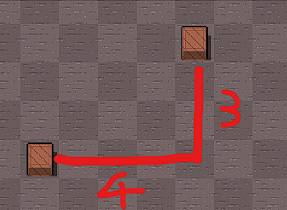
To calculate your ‘Fall-Off’, count the number of squares between you and your opponent. Do not count the squares you and your opponent are standing on. For each square between you and your opponent, you lose 10% accuracy.
To determine the squares between you and your opponent, identify the longest side, count its squares, subtract one, and that’s the gap. Example: If the longest line is 4 squares, deduct 1 for a result of 3 squares. This implies a 30% accuracy reduction when attacking from this distance.
Fire Weapon:
Each weapon has 3 main values, ‘BBs per turn (BBpt)’, ‘Accuracy’, and ‘Damage’.
roll d10’s equal to the number of ‘BBs per turn’ on your weapon/item. A BB will hit your opponent for each roll that falls inside of your ‘Accuracy’. So if you had 60% accuracy, a roll of 1 – 6 would hit. Count the amount of BBs that have hit and times this by your weapons/items damage to calculate the total lives lost for your opponent.
Note: On the d10, the 0 counts as a 10.
Example: The Pistol, firing 3 ‘BBs per turn’ with a 60% ‘Accuracy’ and 1 ‘Damage,’ involves rolling a d10 three times. Each roll between 1-6 results in 1 hit. If, for instance, you roll a 3, 2, and an 8. That means 2 BBs hit, and the total damage is 2 (BBs) multiplied by 1 (damage), resulting in a total damage of 2.
Action Cards:
In the middle of the board is a chest. Your turn ends when you land on the chest, even if you have remaining speed to use. Draw an Action card, you do not have to reveal it to your opponent unless the card causes you to take damage. Action cards can be played at any time, and can be used only once. Once someone has collected an action card, the chest is empty. The chest refills when a player is sent back to respawn.
Unique Cards:
Tripwire: can only be placed on a space you just walked on. Do not let your opponent/s know where you placed it. Write down the coordinates of where you placed the tripwire. And when an opponent walks on the trip wire, announce it, their turn ends immediately and they miss their next turn.
How To Win
Reduce your opponent’s lives to 0
Terminology/Additional Rules:
Lives – how much damage you can take before you are out.
Speed – how many spaces you can move per turn.
Points – the currency used to buy weapons/items.
Damage – how much health you lose when hit with 1 BB.
BBs per turn (BBpt) – how many BBs you shoot when you fire your weapon.
Aim Down Sights (ADS) – generally gives the gun more accuracy, but fewer BBs for 1 turn.
Range – how many squares you can throw an item, such as the Rubber Throwing Knife. For example, you cannot use the Rubber Throwing Knife beyond 3 squares away.
Grenade accuracy – To calculate the ‘Fall-Off’ for the grenade, you count the squares in between your opponent and the grenade.
Credits:
Jordan Thomas – For helping me rewrite an early version of the rules. So people could actually comprehend what I wrote.
Josh & Sarah (Board at Home) – For making multiple playthrough videos for this game and providing essential feedback for the game.
PLAY